

The Civil Recruiter is a niche recruiting firm specializing exclusively in civil, structural, and geotechnical engineering. Bill Krell operates as a partner and independent operator within the firm, running placements across the United States.
The firm's entire value proposition is built around depth of focus. By narrowing entirely to structural and geotechnical engineering, The Civil Recruiter has become one of the most recognized names in that space. Engineers come to them specifically because of the niche authority they have built over time.
Bill was referred by Alex, an ex client who runs The Reverse Recruiter and had already implemented Kinetyca's outbound system.
Bill had built real pipeline on both sides of the recruiting equation. Engineers were coming to him looking for new roles. Firms were coming to him looking for talent. The niche was working.
The constraint was time. Bill had hard limits on how many candidates he could actively work with and how many companies he could reach simultaneously. The work that needed to happen between a candidate call and an actual placement, sourcing, researching, reaching out, tracking, was fully manual and happening across a collection of disconnected tools.
The result was a growing backlog of candidates he wanted to help but could not reach companies fast enough for, and companies he wanted to serve but could not find the right candidates quickly enough for.
- No capacity for systematic outbound: Bill was so focused on filling active roles that there was no bandwidth left to run prospecting in parallel. Valuable candidates were accepting other offers before he could find them a fit.
- Fully manual, multi-tool process: Sourcing required jumping between Juicebox, ZoomInfo, an ATS, spreadsheets, and LinkedIn with no automation connecting any of it. Every step required manual effort and context-switching.
- Heavy cognitive load: Keeping track of which candidates needed which outreach, across which companies, at which stage was an invisible drain that compounded daily. Bill described it as a constant mental backlog he could never fully clear.
- Revenue left on the table: He could identify the missed opportunities in retrospect, watching candidates accept roles elsewhere, but had no system to move fast enough to prevent it.
We designed a two-sided automated outbound engine built around the core structure of how recruiting actually works. Sometimes you have a candidate and need to find the right company. Sometimes you have a company and need to find the right candidate. We built a separate automated flow for each direction.
- Mapped the full recruiting workflow to identify where manual effort was creating the most drag and the most lost revenue
- Defined the two distinct outbound directions the system needed to handle simultaneously
- Scoped the infrastructure around a solo operator, meaning speed of setup, low operational overhead, and immediate notification on every reply
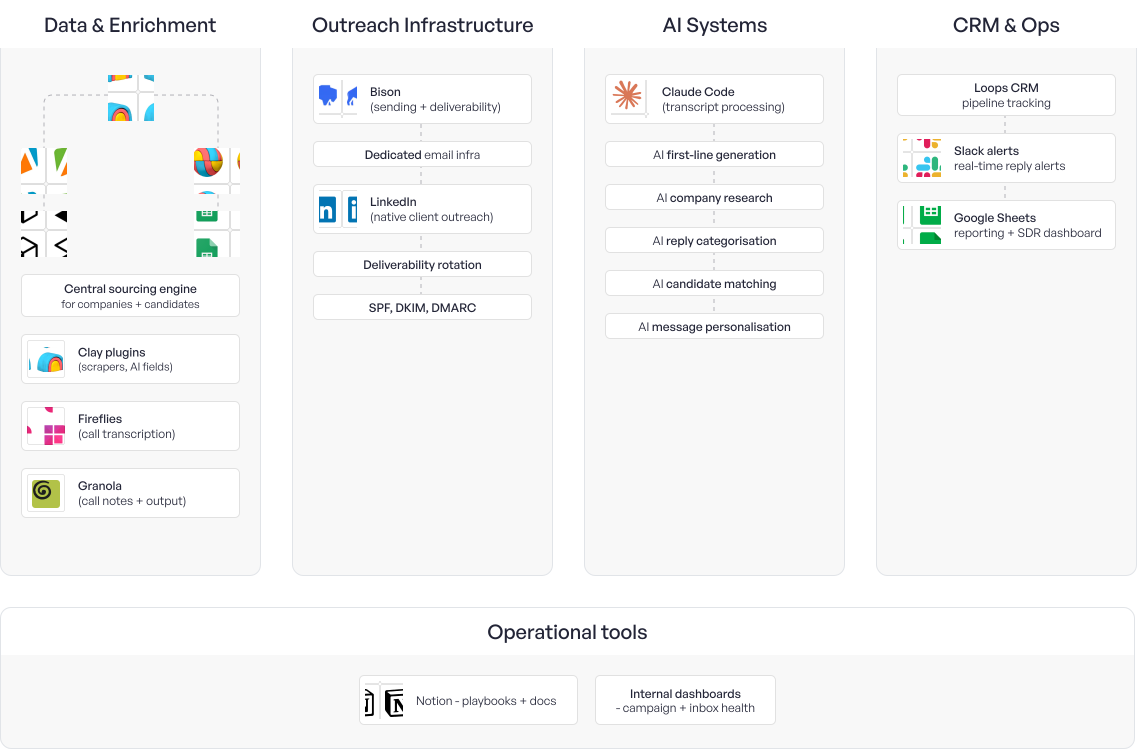
- Bill records candidate interviews using Granola or Fireflies
- Call recordings are automatically transcribed and processed through Claude Code, which extracts structured candidate data and logs it to a Google Sheet
- From Google Sheets, each candidate record is automatically pushed to Clay
- In Clay, we run a multi source scrape to find companies that are either actively hiring for that role in that location or likely to be hiring based on firmographic signals. Sources include Apify, Sculptor, and Clay's native enrichment stack
- For each company, we identify the relevant decision maker, typically the hiring manager or HR lead responsible for that role
- Outreach goes out via Bison for email and LinkedIn through Bill's native account so messages stay personal and on brand
- Positive replies are routed to a Slack channel, logged in Loops, the client's recruiting CRM, and tracked in a shared sheet
- When Bill receives a new job order from a company, the company and role details are added to a Google Sheet, either manually or pulled automatically from a call
- Clay builds a targeted list of engineers that match the role criteria, sourced and filtered by location, specialization, and seniority
- Outreach goes out to candidates via email through Bison and LinkedIn through Bill's native account
- Replies are handled through the same notification and CRM routing as the candidate to company flow
- Connected all reply data from both flows into Loops, the client's recruiting CRM
- Built Slack integrations for real time reply alerts so Bill could respond to interested parties the same day
- Structured pipeline by candidate and company so Bill had a live view of active outreach across both sides
- Enabled meeting booking and CRM updates directly from Slack notifications to keep the response loop as short as possible



Book a strategy call to build an outbound engine like this

Colleva needed to understand their market, their ideal customers, and their message. As an early-stage company, they were still finding product market fit and needed a clear way to test who would respond and why.
We worked with BIGVU to build their outbound motion from scratch, targeting real estate agents and brokers by scraping Zillow listings and layering social signals to personalise every message.